Choosing the right paper for your coloring pages doesn’t have to be complicated. Whether you use crayons, colored pencils, or markers, the paper you print on can make a real difference in how the page feels, how colors look, and whether ink bleeds through to the back.
This guide keeps things simple. We’ll start with the best all-around choice for most people, then break it down by coloring tool so you can find exactly what works for you.
The Short Answer
If you want to keep it simple, here’s our suggestion:

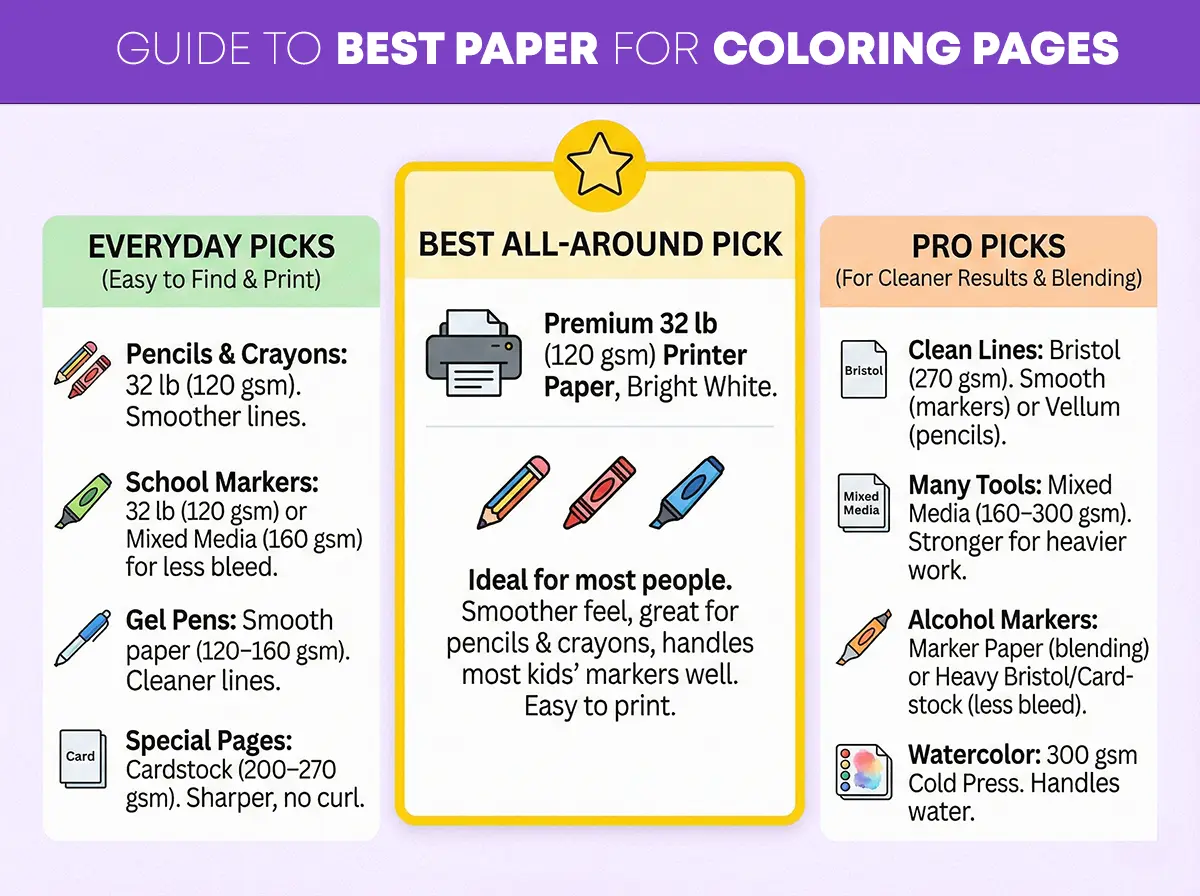
32 lb premium printer paper (about 120 gsm), bright white, Letter or A4 size.
It’s thicker than standard copy paper, works well with colored pencils and crayons, and handles most kids’ markers without too much bleed-through. You can buy it at any office supply store or online.
If markers are your main tool (especially alcohol-based ones), keep reading. We cover that below.
What matters when choosing paper
1) Thickness (how thick the paper is)
Paper is usually labeled as:
- US: lb (like 20 lb, 24 lb, 32 lb)
- EU: gsm (like 80 gsm, 120 gsm, 160 gsm, 300 gsm)
Simple rule:
- 20–24 lb (75–90 gsm): normal copy paper (thin)
- 32 lb (about 120 gsm): thicker printer paper (great for everyday coloring)
- 160–200 gsm: art paper (stronger, better for markers)
- 270–300 gsm: very thick (best for heavy marker use, paint, or water)
2) Surface feel (smooth vs a little rough)
- Smooth paper: best for markers, gel pens, fine lines
- Slightly rough paper: best for colored pencils and crayons (it “grabs” color better)
3) Bleed-through (ink going to the back)
Markers can soak through. Thicker paper helps, but some markers will still bleed.
Easy fix: put a spare sheet under the page.
4) Printer-friendly
Very thick paper can jam some home printers. If your printer struggles:
- Use the rear feed (if you have it)
- Print one sheet at a time
- Choose “Heavy paper” in printer settings (if available)
If you need to know how to print our coloring pages, check our printing guide.
Best Paper by Coloring Tool (Everyday picks)
This section covers the most common tools kids and parents use at home or school. Each recommendation includes a shopping phrase (“What to search for”) you can search for online or in-store.
For colored pencils and crayons
32 lb / 120 gsm premium printer paper is all you need. It’s smooth enough for clean lines but has just enough grip for pencils and crayons to lay down color nicely.
What to search forPremium printer paper, 32 lb, bright white.
For school markers and felt-tip pens
Water-based markers (like Crayola) work fine on 32 lb / 120 gsm paper for light coloring. If your kids press hard or layer colors, step up to mixed-media paper around 160 gsm. It handles the moisture better and resists bleed-through.
What to search forMixed media pad, 160 gsm (also listed as 98 lb in the US)
For gel pens and fineliners
Smooth paper between 120 and 160 gsm is ideal. It keeps lines sharp and prevents the fuzzy edges that gel pens sometimes leave on rougher paper.
What to search forSmooth drawing paper, 120–160 gsm.
For printing special pages (thicker, sharper feel)
When you want something that feels more like a real art print, for a gift, a framed piece, or a page you really love, use cardstock in the 200–270 gsm range. It’s sturdy, prints well, and withstands heavy coloring.
What to search for“Cardstock, heavy, 200–270 gsm”. In the US, you may also see “110 lb index” or “80–100 lb cover.”
Pro picks (for people with more time and budget)
These are for cleaner results, better blending, and less bleed-through.
1) Bristol paper (great for clean lines and strong pages)
Best for: colored pencils, gel pens, fineliners, and many markers
Look for: Bristol pad, 270 gsm (often 100 lb)
Surface choice:
- Smooth Bristol: best for markers and pens
- Vellum Bristol (a little texture): best for colored pencils
What to search forBristol pad, 270 gsm, smooth (or “100 lb bristol smooth”)
2) Mixed media paper (the “many tools” option)
Best for: pencils + markers + light paint or craft work
Look for: 160–300 gsm
- 160 gsm: great daily “pro-ish” choice
- 300 gsm: stronger for heavier work
What to search forMixed media, 160 gsm or Mixed media, 300 gsm
3) Alcohol markers (Ohuhu/Copic-style)
Alcohol markers are the hardest on paper. You have two strong choices:
Option A (best blending): Marker paper
Best for: smooth blending and layering
Note: Many marker papers are intentionally thin, so bleed-through can still occur.
Shopping words:
- “Marker paper pad” (often around 70–190 gsm)
Option B (less bleed-through): Smooth, thick paper
Best for: less bleed-through and stronger pages
Look for: Bristol 270 gsm or heavy cardstock 200–270 gsm
Tip: Even with thick paper, use a spare sheet under the page.
4) Watercolor pencils + any water brush use
Best for: anything with water
Look for: Watercolor paper, 300 gsm (often called 140 lb), cold press
What to search forWatercolor paper, 140 lb / 300 gsm, cold press
Quick “what should I buy?” list
If you want a simple paper setup that covers almost everything, here’s what we’d suggest keeping on hand:
- Everyday printing: 32 lb / 120 gsm premium printer paper
- Marker-friendly upgrade: Mixed media paper, 160 gsm
- Heavy-duty/special pages: Bristol smooth 270 gsm or cardstock 200–270 gsm
- Water-based work: Watercolor paper, 300 gsm
Most people only need the first one. Add the others as your coloring gets more serious, or when you find a page you want to turn into a keepsake.